WHY CHOOSE US
Comprehensive Women’s Health & Advanced Dental Care
At Srijan Hospital, we bring world-class healthcare to women and families with a dedicated focus on compassionate, outcome-driven medical care. Led by distinguished specialists, our hospital integrates advanced Reproductive Medicine, High-Risk Pregnancy Management, Gynecology, and Comprehensive Dental Care in a state-of-the-art facility.
Whether you are navigating complex infertility, preparing for a high-risk delivery, or maintaining your oral health, our team provides personalized care tailored to every stage of your journey.
Meet Our Team
Dr. Vishal Thakur
Dr. Vishal Thakur Senior Obstetrician, Gynecologist & Fertility IVF Specialist (15+ Years Experience)
Leadership: Director at Srijan Hospital | Clinical Director at Indira IVF Vadodara.
Core Expertise: CESAREAN DELIVERY ; Advanced IVF/ART
Obstetrics: High-Risk Pregnancy Care, High-Risk Cesareans & OBS Gynec Ultrasound.
Specialized Care: Recurrent Pregnancy Loss Management.
Dr Kratika Vishwakarma
5 Years of Clinical Experience
Dr. Kratika Vishwakarma offers expert dental care focusing on preventive, restorative, and cosmetic oral health treatments.
With 5 years of hands-on experience, she ensures every patient receives gentle, precise, and comfortable
dental care tailored to their individual needs.
Key Clinical Expertise:
Preventive & Cosmetic Dentistry
Restorative Treatments (Fillings, Crowns, Bridges)
Pregnancy-Safe Dental Care & Gum Health Management
Pediatric & Family Oral Health Care
Media Coverage
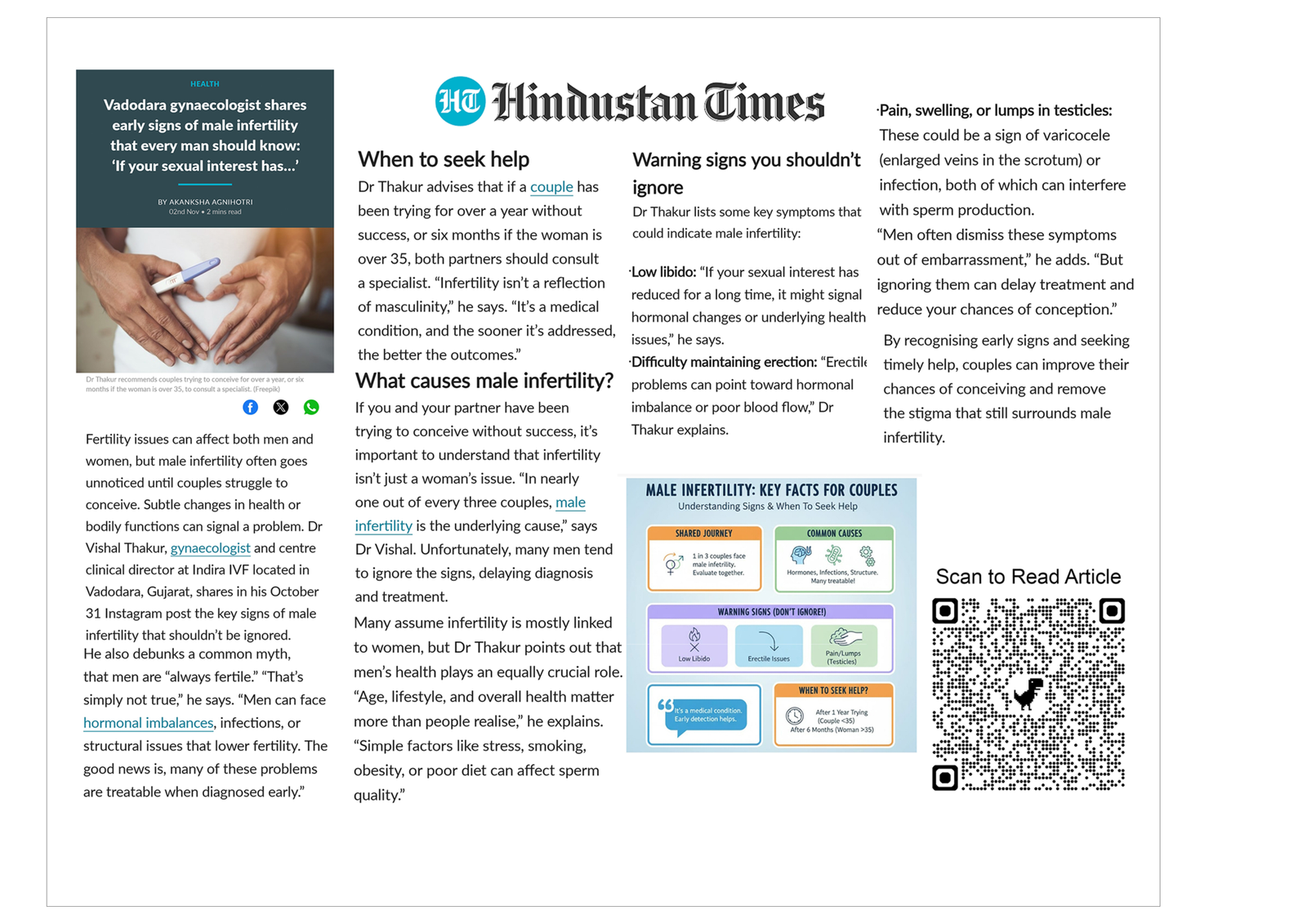
Male factor infertility- news coverage Vadodara fertility expert Dr Vishal Thakur
Hindustan Times
Published on: Nov 2, 2025, 13:25:07 IST
Vadodara gynaecologist shares early signs of male infertility that every man should know: ‘If your sexual interest has…’
Many couples struggle to conceive, but infertility isn’t always a women’s issue. Gynecologist shares key signs of male infertility men shouldn’t ignore. Fertility issues can affect both men and women, but male infertility often goes unnoticed until couples struggle to conceive. Subtle changes in health or bodily functions can signal a problem. Dr Vishal Thakur, Gynaecologist and Centre Clinical Director at Indira IVF located in Vadodara, Gujarat, shares in his October 31 Instagram post the key signs of male infertility that shouldn’t be ignored.
What causes male infertility?
If you and your partner have been trying to conceive without success, it’s important to understand that infertility isn’t just a woman’s issue. “In nearly one out of every three couples, male infertility is the underlying cause,” says Dr Vishal. Unfortunately, many men tend to ignore the signs, delaying diagnosis and treatment.
Many assume infertility is mostly linked to women, but Dr Thakur points out that men’s health plays an equally crucial role. “Age, lifestyle, and overall health matter more than people realise,” he explains. “Simple factors like stress, smoking, obesity, or poor diet can affect sperm quality.”
He also debunks a common myth, that men are “always fertile.” “That’s simply not true,” he says. “Men can face hormonal imbalances, infections, or structural issues that lower fertility. The good news is, many of these problems are treatable when diagnosed early.”
Warning signs you shouldn’t ignore
Dr Thakur lists some key symptoms that could indicate male infertility:
- Low libido: “If your sexual interest has reduced for a long time, it might signal hormonal changes or underlying health issues,” he says.
- Difficulty maintaining erection: “Erectile problems can point toward hormonal imbalance or poor blood flow,” Dr Thakur explains.
- Pain, swelling, or lumps in testicles: These could be a sign of varicocele (enlarged veins in the scrotum) or infection, both of which can interfere with sperm production.
“Men often dismiss these symptoms out of embarrassment,” he adds. “But ignoring them can delay treatment and reduce your chances of conception.”
When to seek help
Dr Thakur advises that if a couple has been trying for over a year without success, or six months if the woman is over 35, both partners should consult a specialist. “Infertility isn’t a reflection of masculinity,” he says. “It’s a medical condition, and the sooner it’s addressed, the better the outcomes.”
By recognising early signs and seeking timely help, couples can improve their chances of conceiving and remove the stigma that still surrounds male infertility.
India TV
Published: ,Updated:
Male fertility and ageing: Doctor explains how sperm changes after 35
For years, fertility has mainly been discussed with regard to women. However, physicians now emphasise a salient fact: men, too, undergo age-related infertility decline, and its contribution to conception is much greater than assumed by most. Dr. Vishal Thakur, Centre Clinical Director at Indira IVF Hospital, Vadodara, explains what ageing really does to male sperm.
How age changes sperm
From the mid-30s, and more sharply after 40, there is a decline in seminal quality. The motility of sperm decreases, semen volume reduces, and abnormally shaped sperm become more common. The genetic material inside sperm is also at risk of damage due to ageing. This doesn’t mean men stop being able to father children; it does mean the chances of natural conception reduce, and the success rates of IVF or ICSI may be lower.
Why sperm DNA damage matters
DNA fragmentation is one of the major concerns in ageing men, where small breaks occur in the sperm’s genetic material. These breaks can interfere with embryo development, increase the risk of miscarriage, and make fertility treatments less successful. According to Dr. Thakur, this damage mainly occurs due to oxidative stress.
Why these changes happen
Ageing impacts multiple systems linked to fertility. Testosterone levels decline gradually, slowing the production of sperm. The testes also become less efficient, reducing both quantity and quality.
Lifestyle still plays a big role
Apart from age, lifestyle choices also play a role in male infertility. Including antioxidant-rich foods in diet, avoiding alcohol consumption and smoking, and maintaining a healthy weight are some ways men can improve sperm quality as they age.
What this means for men planning fatherhood
Age does not stop men from becoming fathers, but it does change the biology of sperm in ways that can influence conception and pregnancy outcomes. It’s only after understanding these changes that men can plan better, maintain good health, and make sensible decisions about family-building. Fertility is truly a shared responsibility, and recognising the role of male age is an essential part of that journey.
Why Choose Srijan Hospital?
Proven Leadership: Supervised by Senior IVF and Gynecological Specialists with 15+ years of experience.
Diagnostics- In house ultrasound - Obs- Gyn, Dental X-Ray
Complete Family Wellness: Combined medical expertise in women's healthcare and dentistry for your convenience.
Patient-Centric Approach: Transparent treatment plans with a strong focus on clinical success, safety, and patient comfort.
WHO WE ARE
Dr Vishal Thakur
15 years experience
Advanced Maternity & Gynecological Care
- High-Risk Cesarean Deliveries: Expert surgical management for maternal complications.
- Obs-Gyn Ultrasound Imaging: High-resolution diagnostic scans for precise fetal monitoring.
- Advanced Gynecological Care: Expert management of Fibroids, PCOS, Endometriosis, and Menopause.
Expert Second Opinion: Infertility, IVF Failures & Recurrent Losses
- Repeated IVF / IUI Failures: Detailed reviews of past stimulation protocols and transfer techniques to uncover hidden causes.
- Recurrent Miscarriages: Specialized evaluations for genetic, hormonal, or immunologic factors causing repeated pregnancy loss.
- PGT-A & PGT-M Guidance: Advanced genetic testing to screen for chromosomal abnormalities, prevent inherited disorders, and maximize transfer success.
- Unexplained Infertility: High-precision, customized diagnostic and treatment plans.
“A failed cycle is not the end—it is key data to refine your next successful treatment.”